
CNC Machining China Factory Lead Times: What Drives Them and How to Plan Around a Real Date
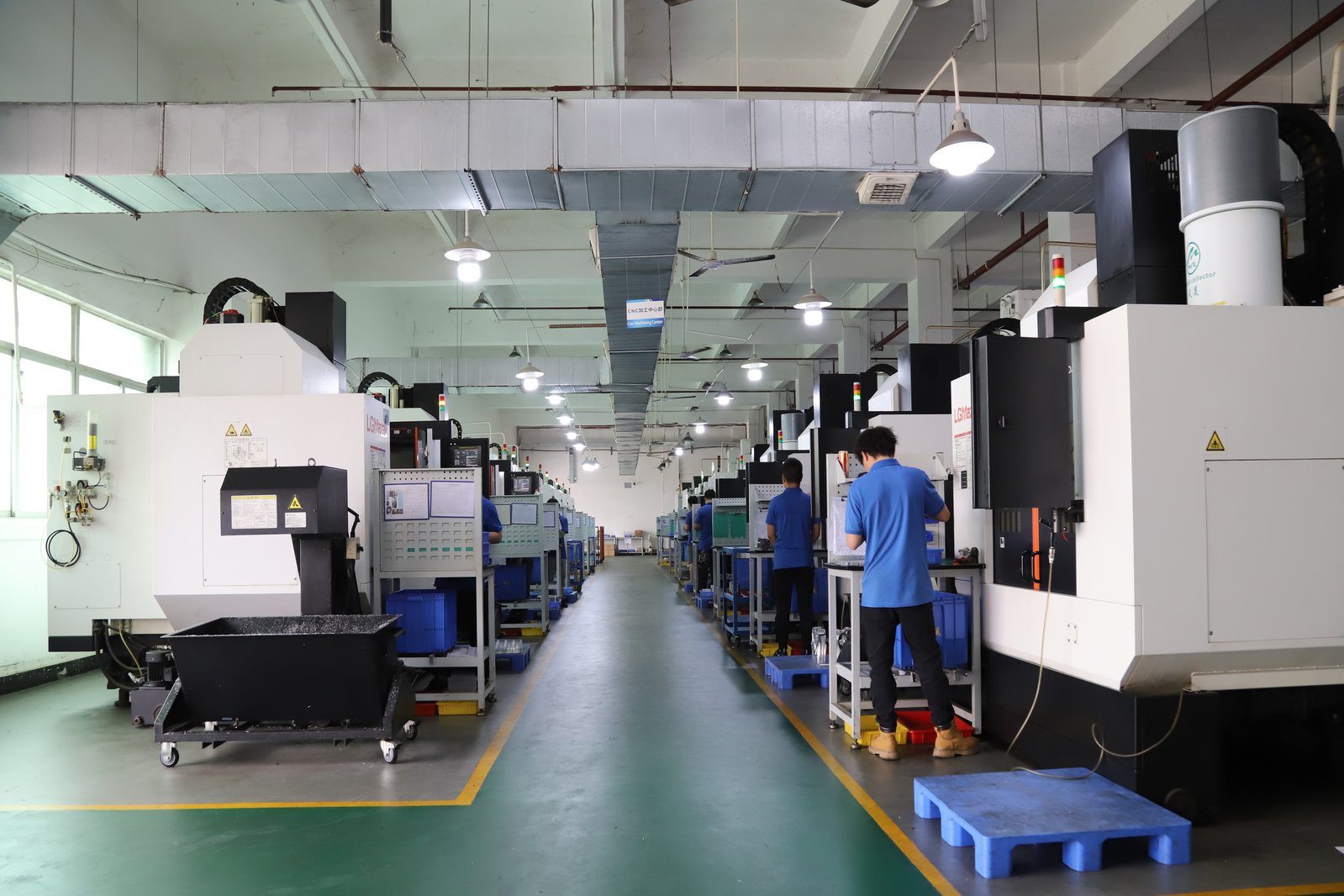
A quoted lead time is a bet the factory is making with your calendar, and the factory is only able to win that bet when the floor behind the quote can deliver. The 3 / 7 / 30-day tiers that run through every quote on this site are shorthand for something concrete: how many operations your part needs, how many machines exist to run those operations in parallel, and whether the metrology that releases a first article sits in the same building as the spindles. When those three things line up, a date holds. When any one of them is missing, the quote is a hope dressed as a number. This guide walks a buyer through reading a CNC machining China factory for its real lead-time behavior — the machine groups that absorb your order, the inspection chain that gates it, and the design decisions that decide how many steps it takes.
What does a factory actually mean when it quotes 3, 7, or 30 days?
The tiers are the plant's own language for process-step count, and a factory that uses them consistently is telling you how it prices the calendar. A three-day quote means the part runs in a handful of operations with no finishing and no treatment — the geometry fits a single machine group and the group has open capacity. A seven-day quote means the part crosses several operations or two machine families, each adding a setup and a queue. A thirty-day quote means the part carries ten to twenty steps, a finishing run, or a heat-treatment leg — a schedule measured in weeks because the process chain itself is long, not because the plant is slow.
The same factory may quote a different tier on two parts of identical size, and the difference is the drawing, not the machine. Depth of pocket, number of features, whether a tolerance demands a finishing pass, whether a finish is specified at all — every one of those is an operation added or removed before the first tool moves. That is why the factory's DFM review matters to the schedule as much as to the price: each flag it raises on your drawing is a step you can remove while the design is still soft, exactly the logic the main design-for-manufacturability guide applies to cost and quality at volume. Read the tier, then ask what put the part there; the factory that can answer with a list of operations is pricing the real work, and the one that cannot is guessing at the date.
How do machine-group counts translate into a date you can trust?
The number of machines a floor can point at your part is the mechanical limit under every lead-time promise. This plant runs 50+ 3-axis centers, 20+ 4-axis and 20+ 5-axis machines, 25+ lathes, and 7+ grinders under one roof. The reason those counts matter to a buyer is parallelism: when your part is drawn in a 3-axis bracket and the group holds fifty machines, your order is not waiting for a single spindle to free up — it is slotted onto whichever of fifty is next available. Parallel capacity is what keeps a 3-day tier from turning into a 3-week one the moment two customers order at once.
The test a buyer should run is narrower than the total count, and the full machine list with envelope limits is on the factory page for exactly this kind of reading. Ask which machine group your geometry actually needs — 3-axis for a prismatic bracket, turning for a shaft, grinding for a bearing seat — and then how many machines in that specific group can run your envelope. A plant with 80 machines and one that fits your 1200 mm part carries the same delivery risk as a plant with one machine, because the other seventy-nine cannot help you. The honest factory will name the group, the count, and the envelope limit together; a vague answer to that question is the first place a promised date starts to soften.
Why does the inspection room's location change your delivery date?
Between machining and shipping sits the first-article gate, and how fast that gate closes is a physical property of the plant. When the inspection room is beside the machines, a first part is measured and either corrected or released in the same shift — the loop between "cut it" and "prove it" is minutes, not days. When metrology is off-site or outsourced, the first article travels, waits in someone else's queue, and comes back with a report days later; every subsequent correction repeats that round trip. On this floor the inspection bench sits beside the machines, and the instruments are named: coordinate measuring machines for the critical dimensions, optical and surface profilometers for profile and roughness, a spectrometer for alloy confirmation, hardness testers where condition is specified.
The metrology adjacency is not a layout nicety; it is what lets the factory release a corrected first article inside a 3-day or 7-day window at all. A buyer who wants to test it should ask one question: where is the CMM relative to the machines that cut the part, and does the first article get measured before the batch runs or after? The first answer is a schedule fact you can see on a visit; the second is the difference between catching a problem on the first piece and discovering it on the hundredth.
The same measurement chain is what makes a tolerance claim worth scheduling around. This plant holds ±0.003 mm on milled and turned features and ±0.002 mm on precision-ground surfaces, with key characteristics verified at Ppk ≥ 1.67 initial, so when a quote promises a 3-day part at that band, the gate that releases it can prove the band was met rather than assume it.
Where does finishing and heat treatment sit in the calendar, and who owns the step?
Finishing and heat treatment run on a separate clock from machining, because they are batch operations rather than continuous ones. Parts are grouped with other parts, loaded into a run, processed, and unloaded; the run has its own queue and its own minimum size. On this floor the ovens reach 500 °C in-house, so the common heat-treatment routes — aluminum aging and stress relief, the lower-temperature steel treatments — stay inside the building and inside the plant's own schedule. Work above that range, such as titanium stress relief, goes to a qualified partner, and the hand-off is the point where an external queue enters your date.
The buyer's control over this clock is the specification. Anodizing, passivation, and heat treatment are decisions made on the drawing, and every one inserts a batch leg with its own schedule. A part sent out bare stays on the machining clock alone. A part that needs a coating or a treatment pays the batch price in days, and the buyer who names it in the RFQ, rather than discovering it after the first quote, lets the factory schedule the leg from the start instead of inserting it after the price was set. Ask which process steps the plant keeps in-house and which it hands to partners; that split draws the map of where your calendar can stretch.
What can volume change, and what stays fixed no matter how many you order?
Quantity reshapes the cost of the fixed work but not the fixed work itself. Programming, fixturing, and the first-article inspection are paid once per order, and that once is identical whether you order one piece or ten thousand. On a one-piece order that fixed work is the whole job; on a production quantity it is amortized across the parts. That is why a prototype and a short production run of the same part can share a lead-time tier — the calendar cost of the first article does not vanish with volume, it just gets absorbed differently.
What volume does buy is the justification for automation. At a sufficient count a plant can set up bar-fed turning, palletized machining, or a dedicated fixture that runs unattended, cutting the per-part cycle time and tightening consistency. But the automated run still begins with a programmed, proven first article, so the schedule's front end does not shrink with the order size. The planning rule that follows is worth writing down: if a launch date is fixed, order the first articles early enough to absorb the setup and the gate, validate them, and let production follow a proven process rather than starting from scratch. With a minimum order of one piece, the prototype and the batch can share the same machine, the same program, and the same control plan, so the knowledge from the first article carries straight into the run.
How do you turn a quoted tier into a launch date you can defend?
The tier is the factory's answer; the launch date is yours, and the two meet only when the buyer works backward deliberately. Four moves keep them aligned. Move one: have the DFM review done before the design is frozen, because the review costs days at most and every operation it removes is time the schedule does not have to carry. Move two: put the finish and treatment decisions in the RFQ, so the batch legs are scheduled rather than bolted on when someone notices the part needs a coating. Move three: order the first articles early — the setup and the gate are the part of the calendar that volume cannot compress, and they have to land before the countdown to launch starts. Move four: ask the factory to name the tier and the operations behind it, not just hand over a date, because an operation count you can see is a schedule you can audit.
When a factory answers in tier language and names the steps, the buyer has something to plan against and something to hold it to. When the answer is only a date, the schedule logic is invisible and the date will move when the real work surfaces. The factory's own limits are published up front — the envelope it can cut, the tolerance it can hold, the heat-treatment temperature it keeps in-house — and reading those limits before you order is what separates a plan from a hope.
Frequently Asked Questions
What do the 3 / 7 / 30-day tiers on a China factory quote actually mean?
They are the plant's language for process-step count. Roughly 3 days covers simple parts with few operations and no finishing; about 7 days covers parts that cross several operations or two machine families; up to 30 days covers parts with ten to twenty steps, surface finishing, or heat treatment. The tier is set by the geometry, not by how busy the shop is.
Why does machine count matter to my delivery date?
Parallel capacity is what absorbs your order without a queue. A floor with 50+ 3-axis, 20+ 4-axis, and 20+ 5-axis machines can slot your part onto the next available spindle in its group; a plant with only one machine capable of your part carries that single machine's delivery risk. Ask which group your part needs and how many machines in it can run your envelope.
Where does the inspection step sit in my lead time?
Between machining and shipping. If the inspection room sits beside the machines, a first article is measured and corrected in the same shift and the gate fits inside a short tier. If metrology is off-site, every first-article round trip adds days. Ask where the CMM is and whether the first piece is measured before the batch runs.
Does surface finishing really push a part to the 30-day tier?
It pushes a part toward the longer end because finishing and heat treatment run as batch processes with their own queues and minimum run sizes. In-house ovens to 500 °C keep the common treatments on the plant's clock; work above that range goes to a partner and adds an external leg to the date.
Does a bigger order stretch the delivery date?
Not necessarily. The operation count and the first-article setup are the same whether you order one piece or ten thousand; volume justifies automation that cuts per-part cycle time but the first article still has to be programmed and proven. Order first articles early if the launch date is fixed.
Can I get a single prototype from a China factory and scale it without re-qualifying?
Yes, when the prototype and production share the same floor and the same quality system. With a minimum order of one piece, the validation part is cut on the same machines and measured on the same instruments that production will use, and the program, fixture, and control plan from the accepted part become the production process.
What quality systems stand behind the date this factory quotes?
The plant operates under ISO 9001:2015 (certificate 116024/A/0001/UK/En), IATF 16949:2016 (product design excluded) (131941/A/0001/SM/En), and ISO 14001:2015 (116024/B/0001/UK/En). The systems hold the operation to documented material verification, first-article records, and process control — the discipline that keeps a date honest rather than improvised.
Want a China factory date you can actually build a launch around?
Send the drawing and your target date to [email protected] or call +86 13126536955. You will get the DFM flags that are adding steps, the tier the part lands in, the machine group and inspection gate behind it, and a delivery date built on the process chain rather than a guess.